This portfolio project is part of my Data Career Jumpstart, where I am applying my SQL skills to analyze real-world datasets. I have analyzed a 500MB+ World Bank dataset using SQL to demonstrate my proficiency in handling large-scale financial data through structured queries.
Disclaimer: I am not a financial expert or development finance professional. This analysis represents my best effort to understand the IDA dataset and other publicly available information as part of my learning experience in data analytics. Please note that this work shouldn’t be used for making financial or policy decisions. It’s meant to showcase my skills in data analysis and the methods I used in my research.
💡 Main Discoveries
- From 1968 to 2008, Indonesia has been approved to receive approximately $2.89 billion International Development Association (IDA) credits. And, as of now, Indonesia still owes the IDA $144.9 million.
- The highest amount of funding was approved in 2007.
- A total of 77 projects with 80 credit numbers have been recorded.
- The first IDA funding was approved in 1968 for a project to improve irrigation, while the most recent IDA commitment, approved in 2008, was for the “National Program for Community Empowerment.”
- IDA also implemented projects to address crises in Indonesia. For example, the Urban Poverty Project was specifically designed to assist recovery from the 1997-98 crisis.
- Based on the duration between the effective and closed dates, 81% of the credit numbers approved for Indonesia had a duration of 5 to 10 years. And, 60% of the credit numbers are expected to be repaid within a total period of 39 years and 6 months, from the first repayment to the last, which is the longest repayment duration observed.
Data
The data pertains to the International Development Association (IDA) Statement of Credits, Grants, and Guarantees – Historical Data. This dataset was downloaded on January 6, 2026, from the World Bank Group (WBG) public financial data website. The dataset was created on April 21, 2011, and includes information up to November 30, 2025. The World Bank publishes this information monthly, updating it by the 10th business day of each month.
Note that, the IDA Statement of Credits, Grants, and Guarantees dataset takes a “snapshot” approach to track the history of each loan over time. This means that instead of listing each loan just once, it shows multiple updates about the loan from the time it is approved until it is fully paid off or closed. As a result, a single loan appears in multiple rows.
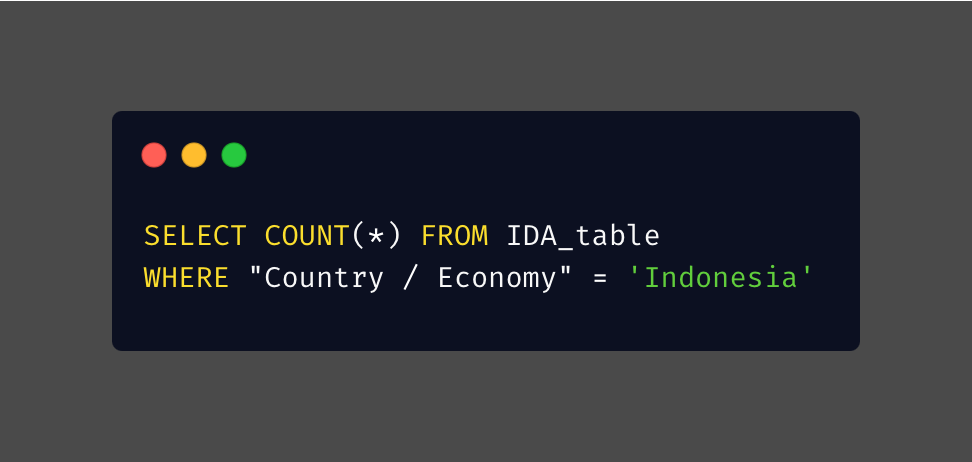
As someone from Indonesia, I find it really interesting to explore this data because it highlights how IDA has supported Indonesia. The dataset contains 14,080 entries that tell the story of Indonesia’s development journey. Each entry represents a real project, showing how IDA financial loans have helped various aspects in Indonesia. For example, a project had focused on enhancing irrigation systems, boosting fertilizer production, and providing better agricultural support, all of which contribute to food security and help farmers thrive.
Analysis
Analysis was conducted using SQL in CSVFiddle.
1. Indonesia’s IDA Journey Over Time
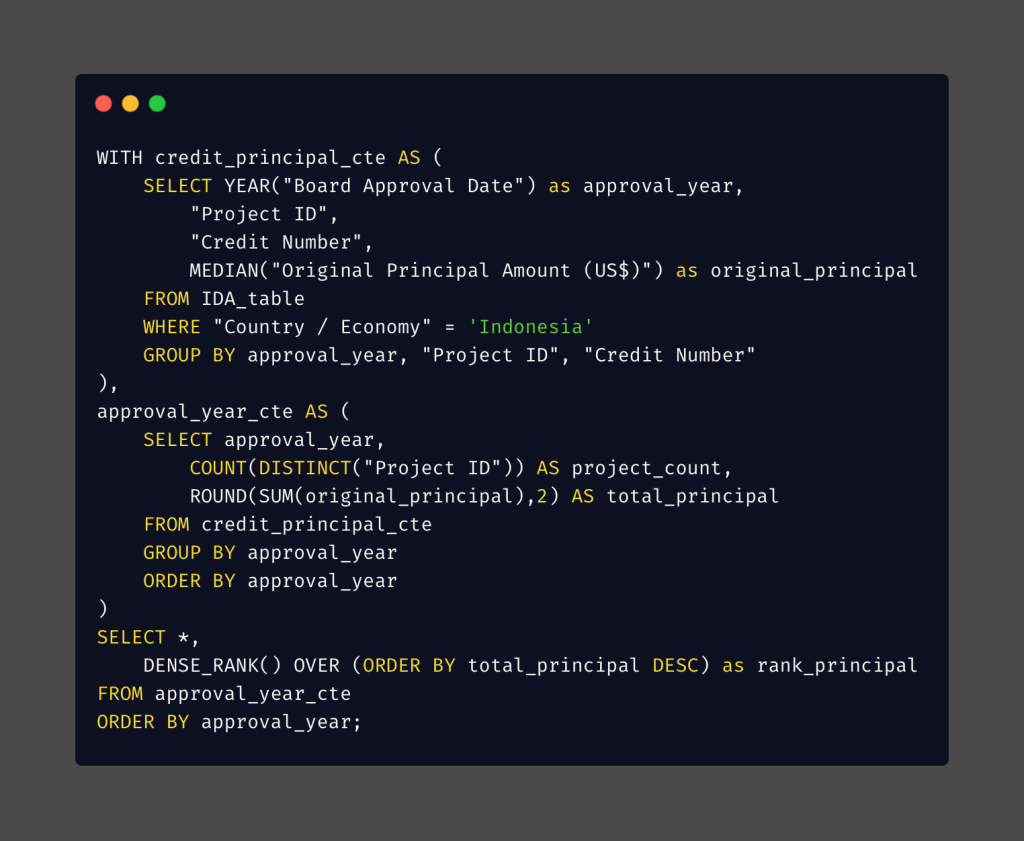
Note for SQL script: since each credit number corresponds to a specific principal amount, the average and median should usually match. However, I chose to use the median in my code because it’s less affected by errors or outliers that could skew the average. This helps ensure my analysis remains accurate despite any anomalies in the historical data.
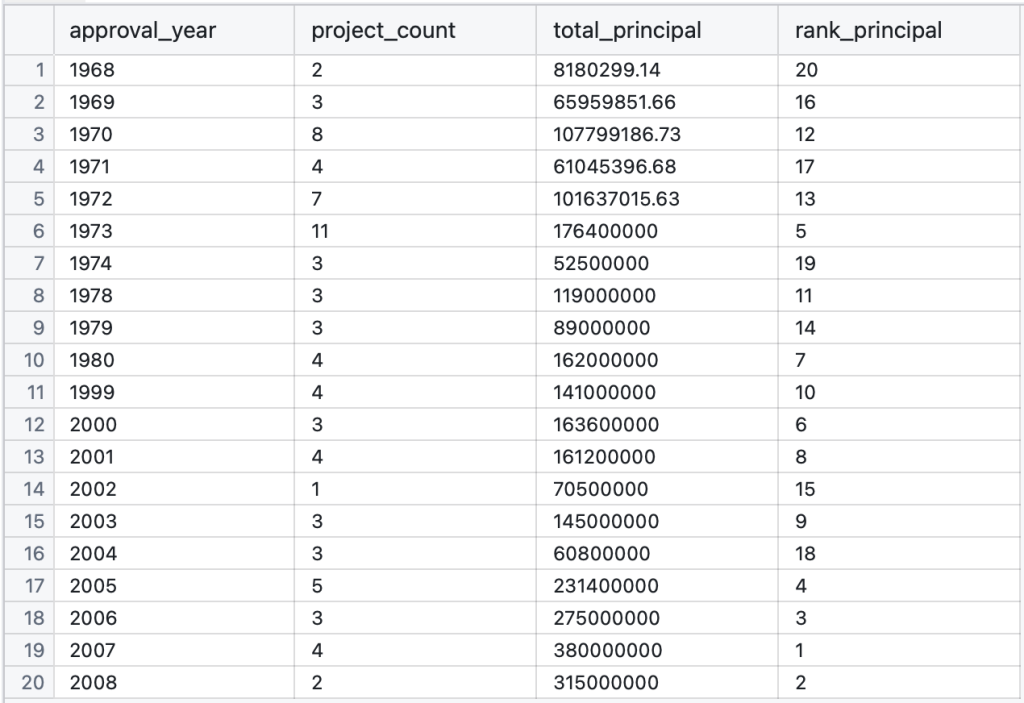
From 1968 to 2008, Indonesia had approximately $2.89 billion in approved IDA funding. The highest amount of funding was approved in 2007. The four largest loans were granted during 2005 to 2008, the final years for which funding was approved in the dataset. Interestingly, the fifth largest loan was actually approved back in 1973, a year when the most projects were approved.
2. Project Analysis
2.a. General Exploration
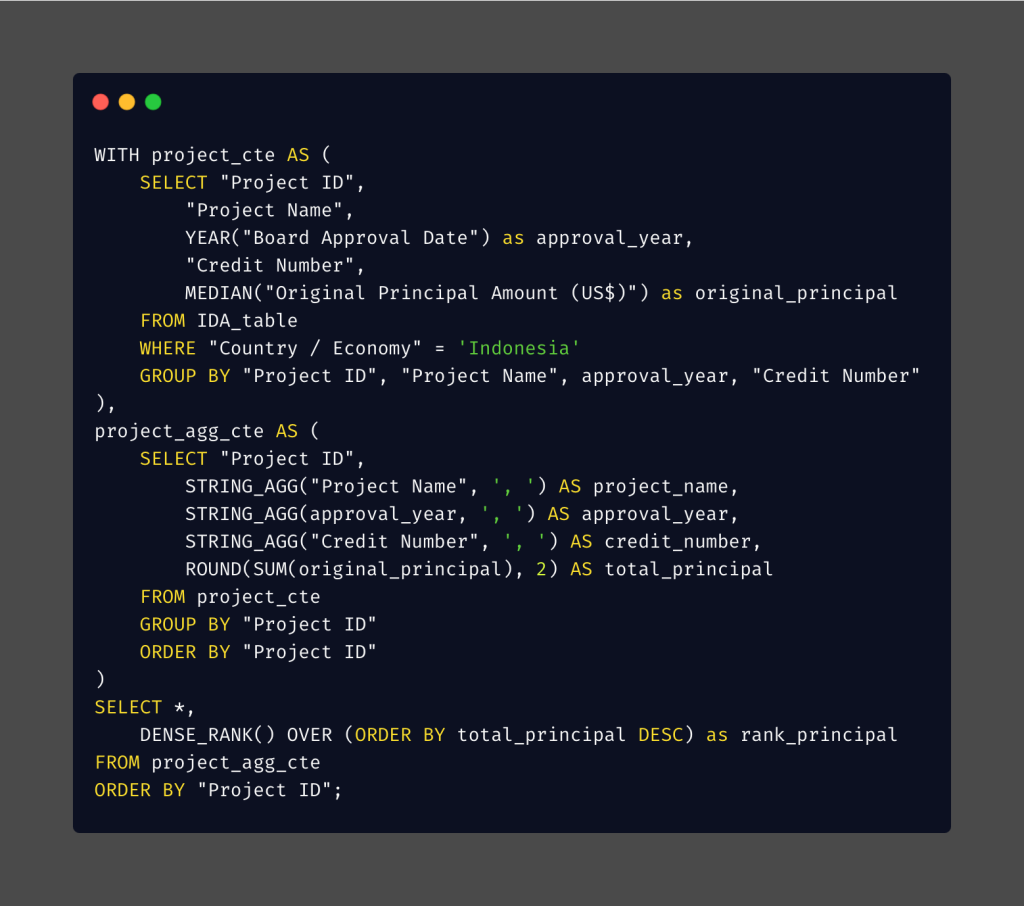
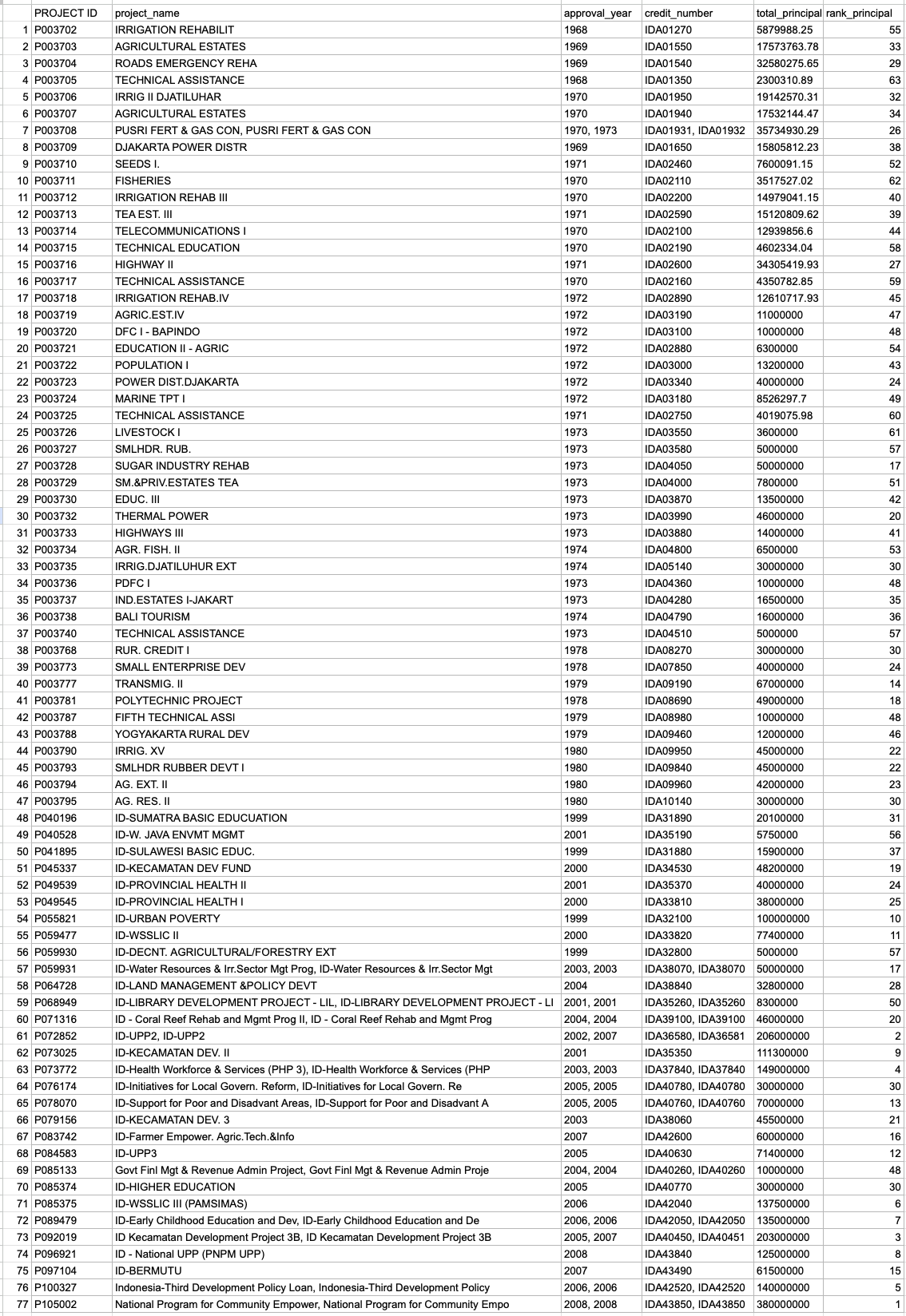
* When I grouped the data by Project ID, I observed duplicate approval years and credit numbers within a single PROJECT ID in the result table, for example P059931, P068949, and P071316. This issue occurred because some project names were truncated in the dataset. As a result, SQL processed these truncated names as separate entities during aggregation.
** I copied the results table from CSVFiddle to Spreadsheet. Since I wasn’t able to take a full screenshot of the table directly in CSVFiddle, using Spreadsheet allowed me to capture the entire table in a single image. This way, I can include the full results in my portfolio.
- The results demonstrate IDA’s wide-ranging support for Indonesia, funding development projects across numerous sectors, such as agriculture, livestock, infrastructure, fisheries, health, education, and electric power.
- A total of 77 projects have been recorded. Of these, three projects were approved in two different years, each time under a different credit number. For example, project P003708 was approved first in 1970 and then again in 1973. Similarly, project P072852 received approval in 2002 and again in 2007, while project P092019 was approved in both 2005 and 2007. This suggests that these projects may need additional funding to continue their efforts.
- The first IDA funding was for a project to improve irrigation, approved in 1968.
- The most recent IDA commitment is for the “National Program for Community Empower”, approved in 2008. This project received the most funding of all projects.
- All credit numbers start with ‘IDA’ followed by a number, indicating that all the funding is provided in the form of credits rather than grants or guaranteed funds. This means the money given must be repaid.
2.b. Projects Approved in 1973
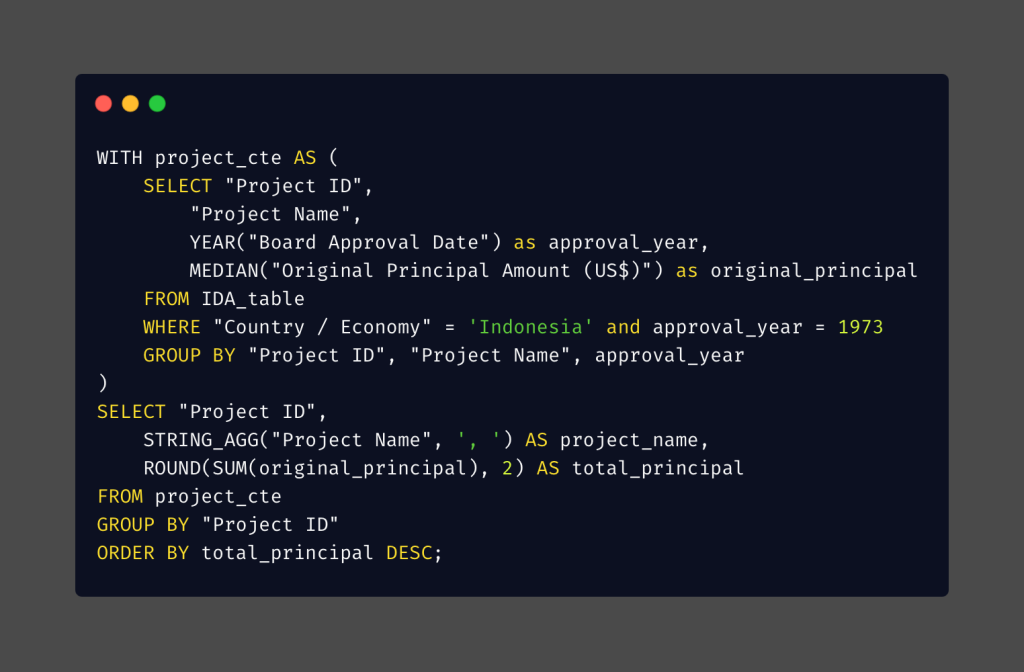
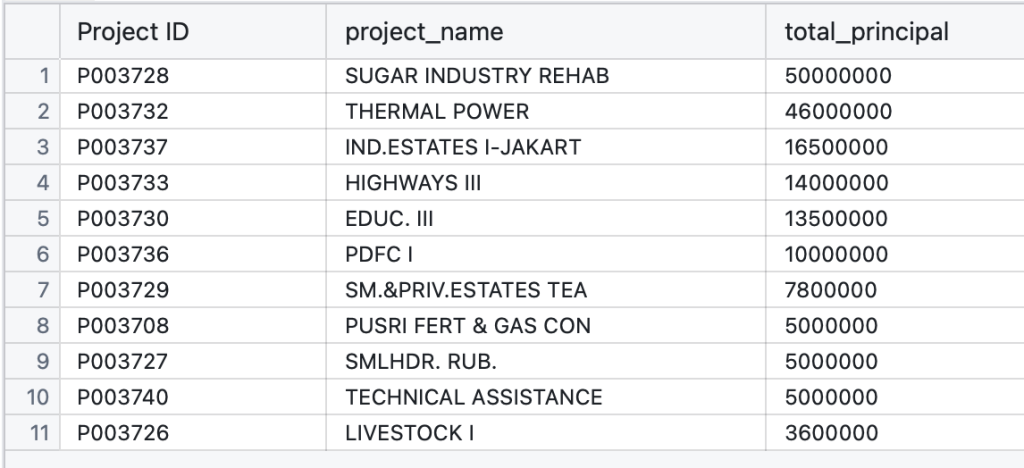
Following up on the analysis in section 1, which identified 1973 as the year with the most projects, I will now review the names of these projects. They span a variety of sectors, including agriculture, livestock, electrical power, infrastructure, and education. The largest principal amount was awarded to a project related to the sugar industry.
2.c. Crisis-Response Projects
In this section, I explore whether there is a specific project name in a particular year that may correlate with the crisis in that year or the year before. Two specific events for analysis are the 1997-98 crisis and the 2004 tsunami.
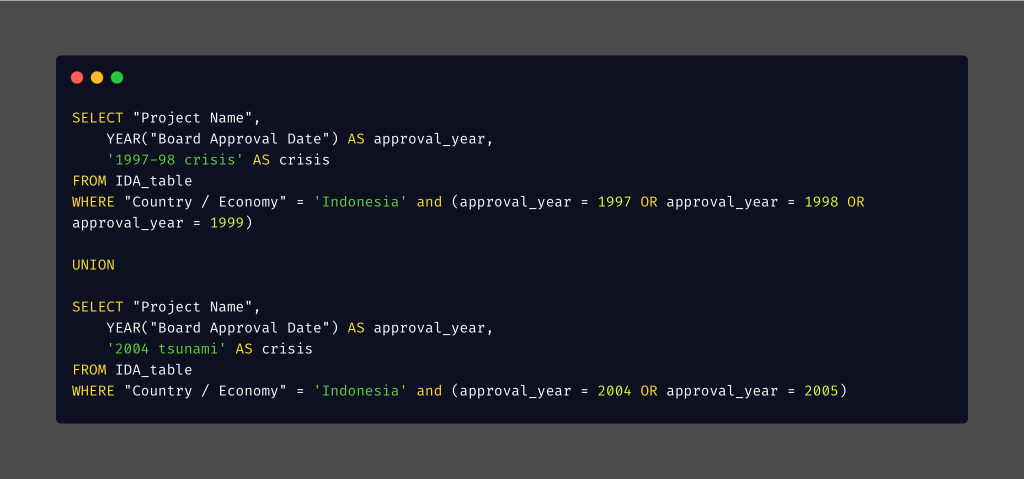
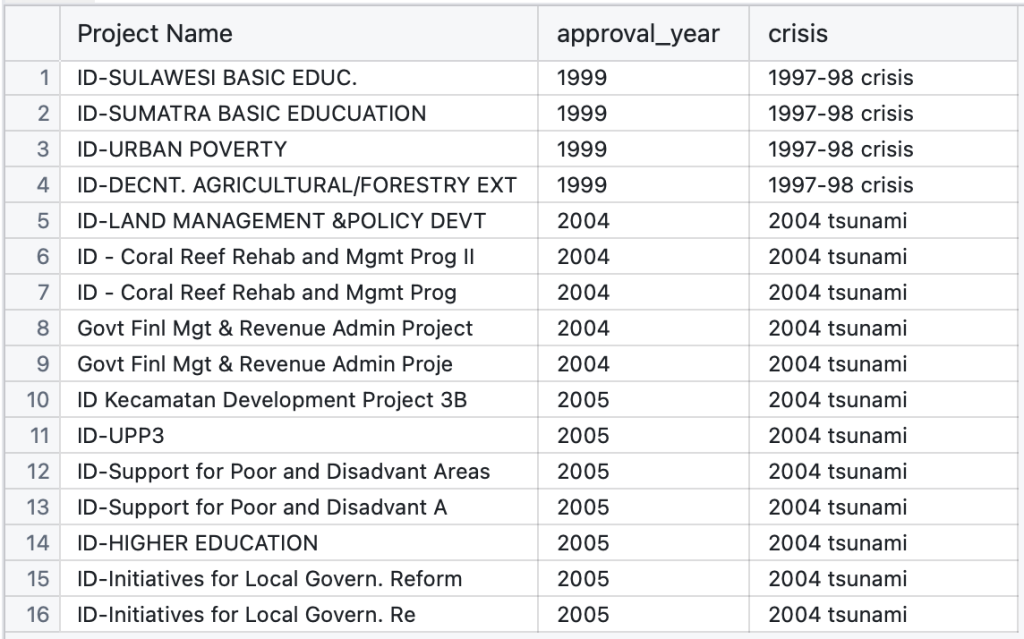
- In relation to the 1997-98 crisis, the “ID-URBAN POVERTY” project may be connected to this event. And, the “ID – Coral Reef Rehab and Mgmt Prod II” project may be linked to the 2024 tsunami.
- Further research in those specific projects: the Urban Poverty project was indeed intended to help with the 1997-98 crisis, while the Coral Reef Rehabilitation and Management Program Phase II was not correlated with 2004 tsunami crisis. The World Bank helped the 2004 tsunami crisis not through IDA but was proposed through a multi-donor trust fund.
- In my previous analysis, I discussed how 1973 had the highest number of projects approved under IDA financing for Indonesia and highlighted projects approved that year. It’s intriguing to explore the context of Indonesia in 1973. A journal published by the University of California Press caught my attention. It describe 1973 as “A Climate of Concern,” when events such as poor rice harvests, and inflationary spiral, and increasing urban unemployment alongside rural underemployment occurred.
3. From Credits to Graduation
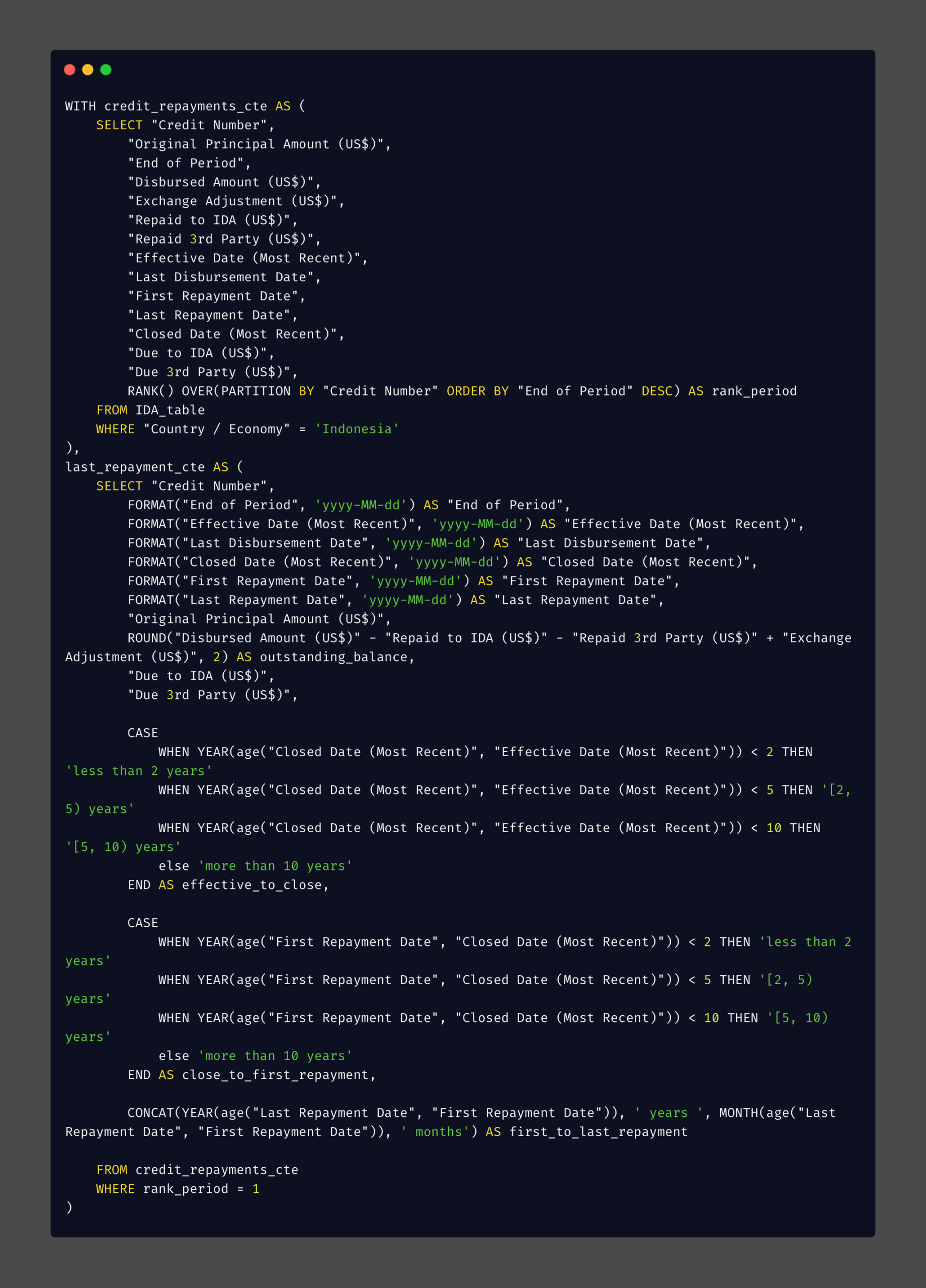
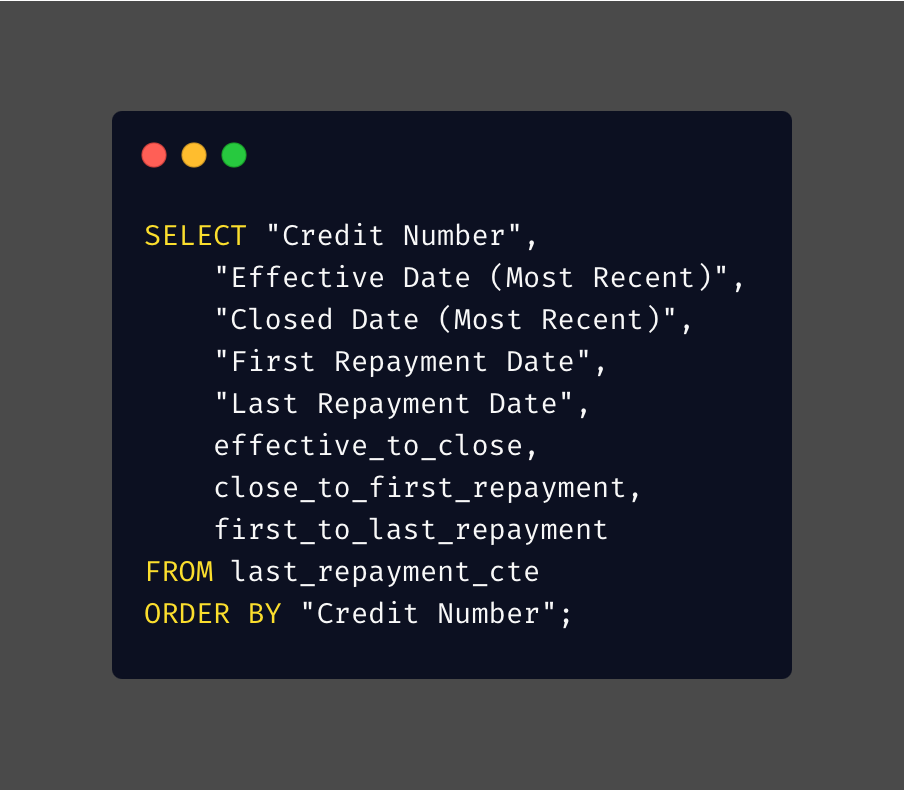
In this section, the analysis is based on two CTEs detailed below. These CTEs include all the necessary parameters for analysis, and the data analysis is based on the credit numbers. I have captured the most recent data for each credit number, focusing on the latest end period.
3.a. Due to IDA and Outstanding Balance
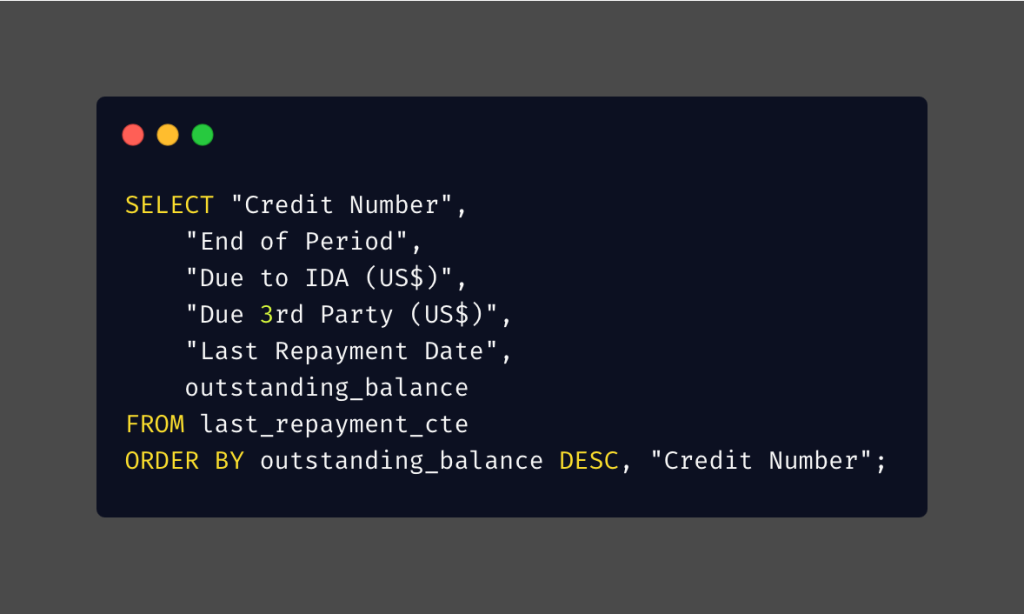
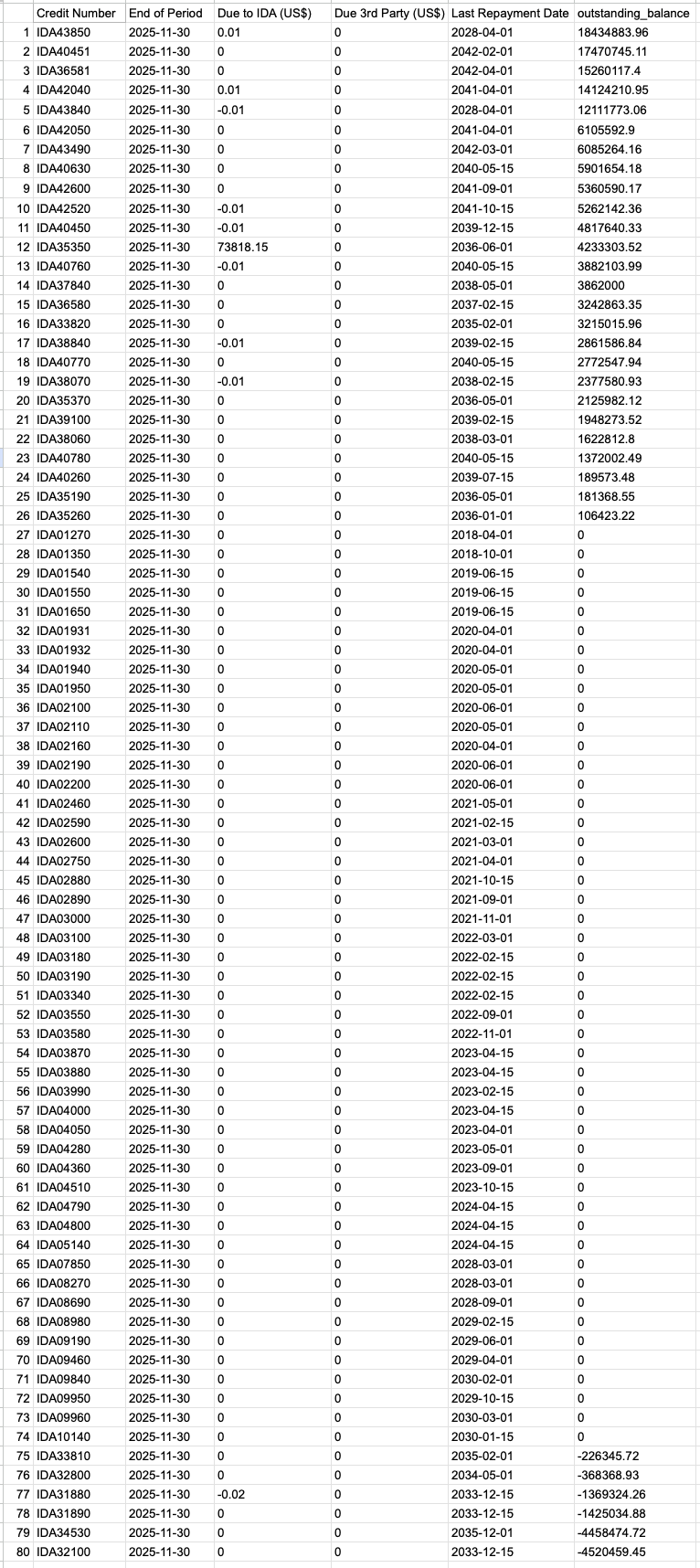
I copied the results table from CSVFiddle to Spreadsheet. Since I wasn’t able to take a full screenshot of the table directly in CSVFiddle, using Spreadsheet allowed me to capture the entire table in a single image. This way, I can include the full results in my portfolio.
- There are 80 credit numbers approved for Indonesia.
- All credit data were current as of the last database update on November 30, 2025. Based on this data, there is only 1 credit number, IDA35350, that is due for $73,818.15. Minor amounts can be disregarded, likely due to rounding.
- Outstanding balance was calculated based on the formula below:
outstanding_balance = Disbursed Amount (US$) – Repaid to IDA (US$) – Repaid 3rd Party (US$) + Exchange Adjustment (US$)
- I noticed 3 categories of outstanding balances: zero balances, positive amounts, and negative amounts.
- A zero balance means that all the borrowed money has been fully repaid. From the table, 60% of credit accounts have been settled.
- A positive amount indicates that Indonesia still owes the IDA, totaling $144.9 million.
- A negative amount suggests that repayments have exceeded the total disbursed amount, which might indicate overpayments due to additional charges such as interest, fees, or penalties. It’s an interesting insight that needs further investigation to better understand the reasons behind each negative outstanding balance.
3.b. Credits Duration
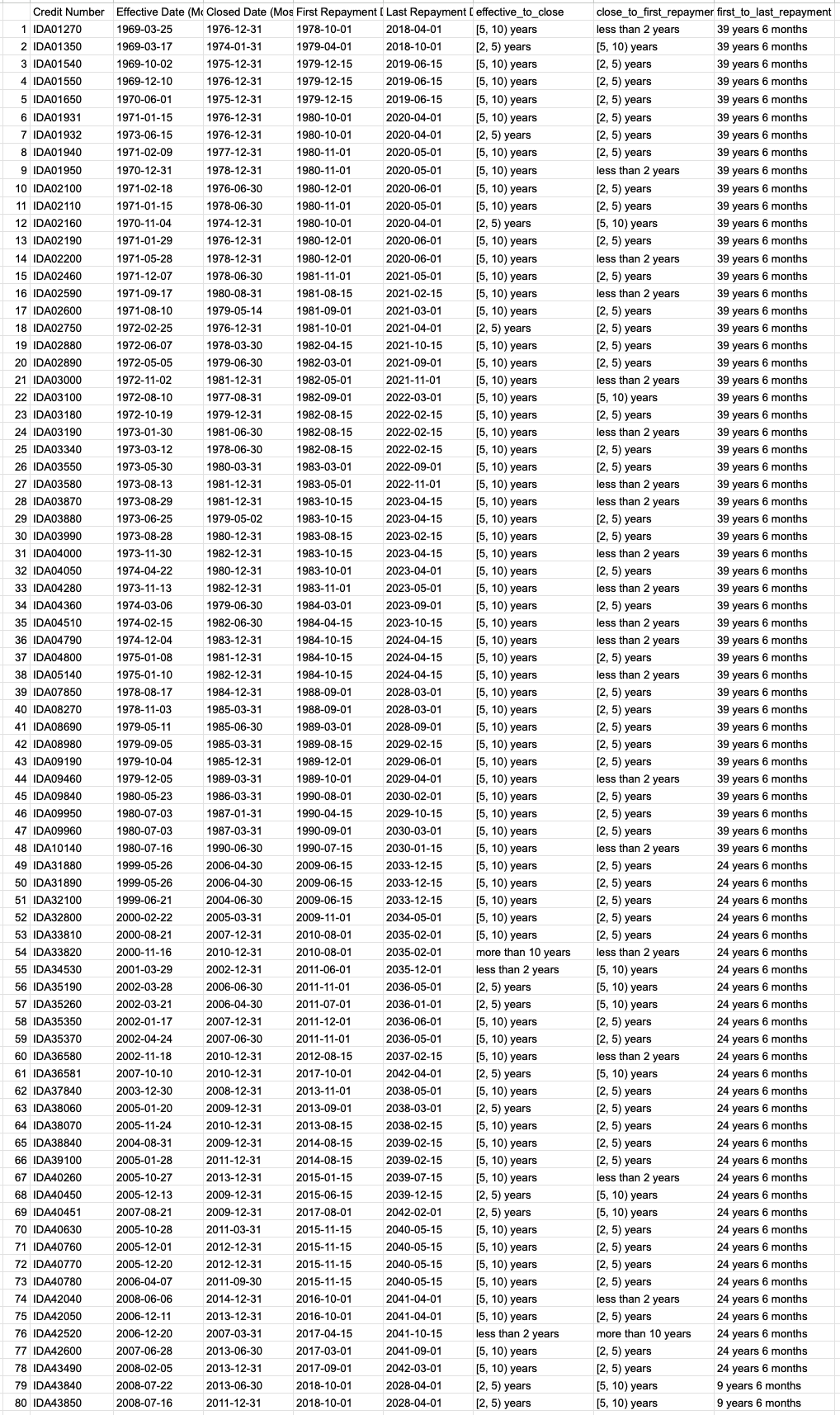
I copied the results table from CSVFiddle to Spreadsheet. Since I wasn’t able to take a full screenshot of the table directly in CSVFiddle, using Spreadsheet allowed me to capture the entire table in a single image. This way, I can include the full results in my portfolio.
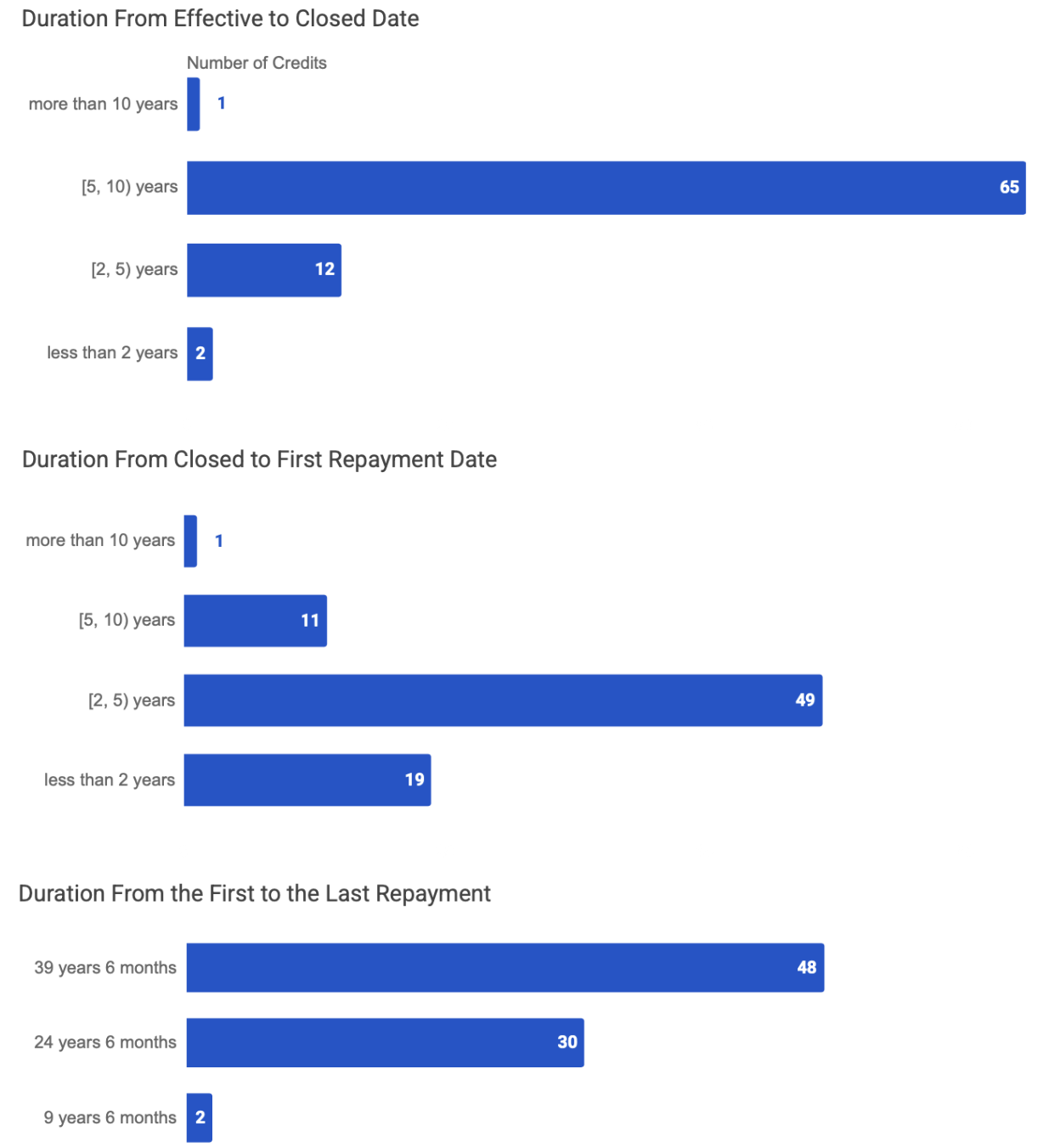
Visualization created in Spreadsheet for better clarity.
I am interested in exploring 3 different credit journey durations.
- From Effective to Closed Date
There is a variety of durations from the effective date to the closed date, which I then categorized into 4 distinct groups for analysis. Based on the duration from the effective to the closed date, 81% of credit numbers approved for Indonesia had a duration of 5 to 10 years. - From Closed to First Repayment Date
Similar to from effective to closed date, duration from closed date to first repayment date also has variety of durations which then I also categorized into 4 categories. Sixty-one percent of credit numbers took 2 to 5 years from the closed date to the first payment date. - From First Repayment to Last Repayment
There are 3 repayment durations: a long-term option of 39 years and 6 months, a mid-term option of 24 years and 6 months, and a short-term option of 9 years and 6 months. Over the duration from the first to the last repayment, 60% of the credit numbers should be repaid within 39 years and 6 months.
References
- Dataset
- International Development Association (IDA) – A Catalyst for Development
- 9 – Indonesia: From Economic to Political Crisis
- 2004 Indian Ocean earthquake and tsunami
- Project Appraisal Document on A Proposed Credit in The Amount of SDR73.5 Million (US$100 Million Equivalent) to The Republic of Indonesia for An Urban Poverty Project
- Indonesia – Proposed Multi-Donor Trust Fund (MDTF) for Aceh and North Sumatra (English)
- Indonesia 1973: A Climate of Concern