Making informed education decisions, such as budget allocation and school policy, requires a clear understanding of the situation across different districts. This dashboard consolidates 2017 data from Massachusetts schools into a single, accessible location, enabling teachers, school leaders, and policymakers to easily identify enrollment trends, resource gaps, and differences across districts. With this information, they can make better decisions for their communities.
I am continuing with the next module in the Data Analytics Accelerator. Currently, I’m working on Module 3 (please see also my project for Module 2).
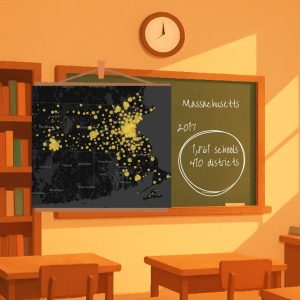
In this course, I learned how to present data in a visually appealing way. For my own project, I chose to design a single-page infographic to add more variety to my Tableau profile. This layout features various visual elements, including bar graphs, pie charts, scatter plots, and maps. These visuals help make the information easier for everyone to understand.
The dataset I worked with contained 298 pieces of information. Still, I chose to focus on just 36 to illustrate the education landscape I wanted to present effectively. You can check out my project on Tableau!
This dashboard provides a look at school data from 2017, offering insights across districts and schools. Teachers, school leaders, researchers, and community members can all find useful information here. It helps them see and compare key details, leading to a better understanding of the school environment. Users can discover important facts, such as student enrollment numbers and available resources, to help them make informed decisions for the benefit of everyone in the community.

Additional note, in Section 3, I noticed that the dataset only provided percentages for each category. To get a clearer picture, I figured out how many students were in each category by calculating those percentages based on the total number of students. This allowed me to present the actual numbers behind the percentages, making the data easier to understand.